Showing posts with label Duchess. Show all posts

Friday, November 26, 2010

Combination Update

Today the newspaper came out of the combination of Duchess & Mary.  When i approached the hive I heard a loud roar from inside which was concerning.  That's usually a sign of colony stress.  On opening the hive many bees took to the air but didn't seem defensive.  It's overcast so maybe they don't like the clouds as bees are know to do.  The newspaper had a good size hole in the middle where i put the slit.  The east edge was also chewed away.


The paper came off the boxes easily enough, just a little scraping.  After i put the hive back together the bees became quiet again.  There are 3 holes in the Vent Box up top.  I closed the 2 on the sides leaving only the front one open.  Hopefully the combination went well and this colony will go into Winter with extra strength.

- - -   - - -   - - -

I finally pulled the HTF off of Myrina too.  There was very little syrup left inside of it.  These bees have gotten their Fumagilin dose.  Her IC went back on and i closed all the holes, except for 1, on her Vent Box as well.  They looked OK from what i could see.  Which wasn't much.

Saturday, November 20, 2010

Combination & the End of Duchess

Last week Duchess seemed to be queenless: agitated bees, many torn down mid-frame queen cells, no brood, & i could not find the marked queen.  Today I went in her looking for either eggs or a virgin queen.  I found neither.  The only option I know of is to do a combination.

I read up on a simple newspaper combination.  You place a sheet of newspaper on top of the good hive and make a small slit in the newspaper.  Then you place one brood box from the weak hive on top of that.  In 24 hours the bees will have chewed through the paper.  This gives the colonies time to acclimate to each other.  Then they will all be 1 colony.

A beek must ensure that a weak colony's queen is pinched or a queenless colony is indeed queenless.  If 2 queens are present in a hive they may fight for dominance. If the better queen is killed by a poor queen the new colony my experience the same problems the weak hive experienced before the combination.  If the better queen is killed by a virgin queen then neither colony has an egg producing queen.  In summer I could get a queen from another beek.  This time of year there are no queens available.  Without a laying queen the colony will die because they can't make up their losses.  The cluster will shrink as bees naturally die.  Eventually the colony will have too few bees to produced the heat they need to survive the Winter.  They won't last long enough into Spring for me to requeen them when queens are available again in May.

 Getting ready to put Duchess on top of Mary

Duchess was combined with Mary.  Mary's performance since her own requeening has been great.  She is a strong colony with ample stores of pollen & honey.  I used Duchess's top Deep box which is full of honey.  Mary's top Deep is also full of honey.  These bees will have over 100 lbs of honey to get through Winter.  I left Mary's bottom Deep on.  So Mary is now a 3 Deep hive.  Duchess's screened bottom board, bottom Deep, & telescoping cover have all been retired.  Duchess's inner cover went on Mary.  Mary's hive top feeder and vent box were also removed.

Mary & Duchess Combined

After Duchess had been put on to Mary I had to dump in the rest of Duchess's bees that were still in her bottom and the quiet boxes.  That was easy but many took to the air.  In a combination no entrance hole is provided to the box on top.  So any flying bees need to sort things out on their own after everything is closed up.  That why you see a cluster of bees on the front of Mary above.  They are the remnants of Duchess figuring out what to do.  In the end they all went in Mary at her entrance.  I was able to watch them slowly craw in.  I wonder if that may be another sign that they were queenless.  Calmly walking into a queen right hive. It's called 'Drift' and it happens when hives are close to each other.  In this case the one hive is gone so the flying bees will drift into the next hive over. 

The newspaper will stay in for at least a week.  I will take it out after that on the next warm day.  After that I'd like to do an inspection on Mary to locate her marked queen.  If she can be found then i know the combination went well.  If not I'll need to watch her for symptom of queenlessness.  Which would mean i'd have lost 2 colonies.

To add to the stress I found my first instance of Small Hive Beetle (SHB) in Duchess as I was taking her apart.  I found a total of 4 on the pollen frames in the bottom box.  SHB are all bad and poop in the hive.  These either came with these bees from Georgia last Spring or from my neighbors hives who also came from Georgia last spring.  The same shipment of packages.

SHB in front of the bee

This poses a big problem since i just combined a SHB infested hive with Mary.  Which means Mary now has SHB.  Isn't that great! I love how this Winter is starting out...  I'll add beetle traps in the hive and read up on them.  As usual a strong colony of bees can manage a few beetles. 

The Bee Yard Now - Myrina & Mary

It's a shame to lose Duchess.  I still think i killed her queen during the last inspection.  It's something that happens so I'll need to be vigilant going forward.  Now I'm thinking about how many packages I'll want to order for next spring.  Or, maybe buy a couple Nucs locally.  I would like at least 2 more colonies next year.
*

Saturday, November 13, 2010

Duchess Queenless?

Not good.  Going into Duchess to add the Apistan treatment I could find no brood or eggs.  The bees were more defensive than normal.  There were many queen cell looking structures that were being torn down by the bees.  Only one of which had an exit hole out the bottom.

 Chewed up Queen Cell

There was plenty of brood last time i was in the hive.  I cant know what happened but my guess is I accidentally mashed the queen during the last inspection.  It looks like they tried to create several emergency queens.  Which may have produced a Queen.  Unfortunately there really isn't any drones left for her to mate with.  Which leaves her a virgin queen, unable to lay eggs to help the colony

Now, maybe she did find a drone and has come back to the hive but hasn't started to lay eggs yet.  I need to check one more time next week to be sure.  If not she's been handed a death sentence.

In the Beemaster forum Michael Bush said that bees from a queenless hive can drift to a queen right hive if it is nearby.  Duchess sits next to Mary.  He also said a queenless hive in Fall can face major robing pressure.

If it turns out she is queenless I plan to combine her with Mary using the newspaper method.   Duchess's top Deep box which is filled with honey will be placed on top of Mary.  All Duchess's bees will be shaken into that one box.  If the combination works Mary will be a very strong colony with more supplies than she can use.  Duchess's bottom Deep box will go into the freezer to be utilized for a different hive in the future.

I will talk to people in the bee club at the meeting next Thursday.  I'll figure out what I'm going to do then.

aun Aprendo
*

Apistan

The Apistan went into all 3 hives today.  2 strips per box.  At 2 Deeps a hive each hive took 4 strips.  Each on the inside of the 3rd frame near the cluster.  Then in the opposite positions in the bottom box.  It staggers out the strips and I believe allows the most contact.  Staggered the strips are not on top of each other yet all four corners are covered. 

 
Installed Apistan strips

The treatment will last 45 days, ideally.  It may be snowing & 20f degrees at that time so I take it out whenever I can at around 45 days.  

Normally I'd like to have the strips in on the first of November but I was late this year.  It shouldn't be a problem though.  Instead of pulling out the strips on December 15th, they'll come out on January 1st.  Either way the queens should have stopped laying so there will be a break in the brood cycle.  Which is the best time for the Apistan to be killing the Varroa mites.  As apposed to Spring when there is no brood cycle break.  Plus I'd have to fight against the timing of the Flow & adding honey suppers; which can't be done while treating.

A 24 hour, non-sugar, sticky board drop from November 1st revealed higher than acceptable mite populations in all 3 hives.  Mary = 123, Myrina = 66, & Duchess = 103.  50 is considered the population threshold. 
*

Monday, November 1, 2010

Fall Mite Count 2010

This is a pretreatment 24 hour drop count onto a sticky board.  The mite population has seemed lower than ever this year.  I didn't want to treat with chemicals so I hoped to put it off this year.

Mary - 123
Myrina - 66
Duchess - 103

So much for not treating.  I typically use Apistan but will look at Apiguard too.  Mary & Myrina's Queens are daughters of VSH queens.  I thought they might have lower counts.  Duchess is new from Georgia and likely brought some with her. 

Mary's Sticky Board

*

Monday, October 25, 2010

Inspection 10/24/10

Duchess
75 f
Sunny


It took longer than it should have but today i finally got into Duchess.  She has seemed more productive than the other two all year.  From her constant wax production to always having more bees flying at any given time.  If this colony can get through Winter than I hope for much honey from her next year.  She's more defensive than Myrina & Mary now that those two have been requeened.  Not at first but after going through a box of frames she can take to head butting.  She is in no way a problem fortunately.

OOPS! - She would have had her last gallon of treated syrup in her HTF today if I hadn't screwed up.  I made it Friday night the 22nd.  On Saturday I went to put it out but it had begun to crystallize already.  So I place the pot back on the burner and set it for medium heat.  I thought after ten or so minutes it would be back to all liquid and good to go.  Sadly I became distracted.  When I finally got back to it the syrup had been boiling for some time.  What a waste.  So I dumped the syrup out.  I had to now that it was toxic.  Four dollars worth of sugar and a teaspoon worth of Fumagilin-B.  I'm still mad at me.  What a dope!  I do not have enough Fumagilin left to make even a single extra gallon of syrup.  So Duchess will  not get her second gallon.  She's the only colony i have that's not had Nosema.  If one of them is going to get only a half dose than it's best to be her.

Ask me how well it worked come March?

Anyway the HTF did have the crystallized remains of the first gallon.  So, afterward, I added a quart of warm water to it.  Thirty minutes after the inspection was over the girls were flying in the typical sugar shock frenzy that follows the addition of syrup. 

Top Box Frames:
10. Full capped honey - 2010 CW
 9.  Full capped honey - 2010 CW
 8.  Full capped honey, back fill - 2010 CW
 7.  Full capped honey, back fill - 2010 CW
 6.  Full capped honey, back fill - 2010 CW
 5.  Full capped honey, some brood cells - 2010 CW
 4.  Full capped honey, some pollen - 2010 CW
 3.  Full capped honey - 2010 CW
 2.  Full capped honey - 2010 CW
 1.  Full capped honey - 2010 CW

Bottom Box Frames:
10. Drawn incomplete empty - 2010 Plasticell
 9.  Drawn incomplete empty - 2010 Plasticell
 8.  1/4 pollen - 2010 Plasticell
 7.  Minor pollen, depleted - 2010 CW
 6.  1/2 Brood - 2010 Plasticell
 5.  1/2 Brood, some pollen - 2010 Plasticell
 4.  1/2 Brood - 2010 Plasticell
 3.  1/2 Brood, Queen Cup - 2010 Plasticell
 2.  1/2 Brood, 1/4 pollen, 1/4 honey - 2010 Plasticell
 1.  Some honey, some pollen - 2010 Plasticell

I could not find the Queen.  I also didn't see any eggs since I forgot to put my glasses on before I started.  I did see some very young larva though.
-
 Extra wax, wrong place

Lots of bur comb on the top of the frames in the bottom box.  I scraped it all away including the propolis on the frame rests.  All the extra wax and still some of the Plasticell frames were unfinished.  They started out in the first box and yet, several of the outer frames were not drawn out completely.  The more I see the more I don't like it.  The Queen cup was well developed but nothing inside it.  
Frame 10, Initial hive box
-

I pulled the SBB and cleaned beneath the hive as well.  The same critters were under this hive as the others.  Wasps & spiders.  It's not a problem but after a whole season it builds up more than I had thought.  The Mud Wasps kept to the hive stand.  They were easy to remove.  The spiders had webbed up under the hive like there would be no tomorrow.
 Mud Wasps
-
 Many egg cases

The worst part of that being the type of spider.  Black Widows are docile creatures I have no problem with.  Except for the fact they could severely harm my kids; and mess me up too.  So she gets mashed every time i find her.  I thought the wood pile was bad but I've found more by the bees.
Charlotte
-

I previously mentioned the portables hive stands.  Nothing more than 4 pieces of wood screwed together.  Yet, they're great for keeping the bottom of a box off the ground; no grass, leaves, or smashed bees.  There never seems to be enough space on the regular stand so these are handy.  First they were used to move the hives to the new spot; 2 feet at a time.  Now they are a spot to put a top box while I'm in the lower box doing whatever.  There will be more uses in the future i'm sure.
Portable stand & quiet box
-

Last, we hit the high 30's this last week for nightly lows.  Frosts are coming.  So today I closed the SBB's in Myrina & Duchess.  Mary only has a solid BB.  I used a piece of luan cut to fit beneath Myrina's hive and slide into the back of Duchess's SBB.  Myrina's is a simple one I bought from Dadant.  Nothing fancy like rear access mite check boards.  So she had to bee lifted to put it on.  Duchess has a homemade one that does have the mite check board.  Her's slid into the back.  This leaves the main entrance as the bottom vent for Winter.  The vent boxes I use release the air up top.
*

Monday, May 31, 2010

Marking Mary & Hornets

Several attempts have been made to mark Mary this year.  None have worked for one reason or another.  Today, though, was the day.

The In-laws are visiting and my father-in-law wanted to see the bees.  So we suited him up with a veil & gloves borrowed from my awesome beekeeping neighbor.  Then we opened up the hive and showed him the bees.  He got a kick out of it and asked lots of good questions.

 Paint drying

The big thrill was marking Queen Mary.  We hunted for her on every frame and, of course, didn't find her until the last frame.  Frame 7 in  the bottom box.  Once we found her it was a mad dash to get her in the marking tube.  She was moving very fast skittering across the frame. It took several minutes the cage her.  Then marking her went quickly.  Allowed a minute to let the paint dry before placing her back on the frame.

Marked Queen Mary

It's a lot of trouble for a Queen i'm about to replace but this will make finding her that day much easier.  Although I must say that her brood pattern in the upper box looked great.  If i didn't know she's a weak Queen I couldn't have guessed it from there.  Solid frames filled with eggs.  I think moving the hives into a sunnier spot in the yard helped immensely. 

---

Also, there's a paper hornets nest by the hives.  I was leaning on the swing watching the bees.  I looked up and noticed the nest 3 feet from my head.  I backed off quickly since I wasn't wearing the bee suit.  Later after I had finished working the bees I went and pestered the hornets some.  Yes they are very defensive but to my chagrin they're not as bad as Myrina!  What does that say?  I would not mind letting them continue to build their nest all year.  Then I get to display their BIG nest on my desk at work come Winter.  The Wife does not agree with me though.  And her 'hive' comes first.  So the hornets will be going away very soon.  Oh well...

Hornets Nest by Hives

The hives you see left to right are: Myrina, Mary, the 2010 package.  All on the new stand.  We are still trying to name the new colony.  It has been over 45 days since they were hived so most of the bees should bee daughters of the queen now.  They are slightly more defensive than Mary but that's not saying much.  They're good little workers and are growing quickly.  Right now we have taken to calling her 'The Duchess'.
*

Tuesday, May 25, 2010

Honey Super and More

 Ready to go on
 
Myrina got her Medium Honey Super put on today.  It was from last year and has drawn out comb on Plasticell foundation.  I added spacers to it so now it's a 9-frame supper.  All the frames were sprayed with syrup before they went it.  Since the frames are drawn I went ahead & put the Queen Excluder on.  I will check in a week to see how they're doing.  Her bees were defensive as usual. 

 New Super & New Stand
-

Mary got another gallon of 1:1 syrup.  The first gallon was about gone.  I had hoped see would have repaired the damaged comb in  Deep Hive Box-2.  But no new comb there.  Her bees are still very active.  She has the earliest flying bees in the yard each morning.

-

The new colony (Duchess) has a small ant problem.  They are getting into the HTF through a gap.  All the equipment is new and because of the HTF the bees do not access to the Inner Cover, Vent Box, & T-cover.  SO, they can't seal everything with propolis.  I flicked out the dead ants.  They are not taking the syrup as fast as Mary but they're still taking it.  I looked in the new DHB and found frames 5 & 6 were almost all the way drawn out.  There was a small piece of bur comb on the top of frame 5 in the first DHB. It was removed.
 
Invaders!
-
Frame 6 in DHB2
-
 Bur Comb

And since the bees have not sealed all the interior wood there has developed a mold problem on the T-cover.  A big green spot of mold above the hole in the Inner Cover.

 Wood not sealed by the bees

I put what wax I had left right on top of the mold spot.  I didn't have enough to treat the whole T-cover.  If the mold gets worse I'll buy some wax and do the all of it. 

Bees wax over the mold.  Problem solved

*
Sunday, May 16, 2010

New Brood Boxes

Yesterdays inspection showed that the New Colony (Duchess) needs an additional brood box.  Today I assembled the crimped-wire wax foundation frames and sprayed them with sugar syrup.  I finished painting 2 Deep Hive Bodies a day ago.  One is for the new hive and the other is for Mary.  I filled one with the frames and put in on the New Colony.  I used the smoker but didn't need it.  The bees were very calm.  The Hive top feeder was full, so that slowed things up a bit.  The 2010 package is now a Double-deep hive.  Moving right along.

I wanted to add-on to Mary today as well but couldn't.  I took her stored frames out of the freezer a few weeks ago to thaw.  Today when i opened the trash bag they were in I saw wax moths.  Dang it!  So i put them back in the freezer for a few days to kill them off.  I thought the trash bag would protect them but was wrong.  Oh well, lesson learned.

Mary's new DHB replaces an old DHB only; no new frames.  It will be filled with the established frames from the old DHB.  It was removed when Mary's population crashed last Winter.  She was reduced to a single DHB at the time.  The established frames are almost full, with honey & pollen.  Though there are some bare areas where I scraped the wax moth damage off.

I'll inspect Mary in a day or so when i can put the new box and frames on.  I expect to find the she has filled her current brood box.  If so it won't take long for her to fill the holes in the second brood box.  That being the case I could feasibly start adding honey supers to her if her population grows fast enough.  Her re-queening is still on schedule as soon as the breeder has them available. 

*

Saturday, May 15, 2010

Inspection 5/15/10

2010 Hived Package (Duchess)
82 f
Partly Sunny


There have been reports of Small Hive Beetle in the packages that many of us received back in April.  My neighbor found one in her new hive and has since taken measures to control it.  I went into the new hive today looking to see if I could find any; hoping I wouldn't.  I went through each frame and didn't see any.  But I missed the Queen as well, and she's marked,  so I'll continue to watch for them.

The Hive top feeder was about at the empty mark.  What little was left had a thin crystallized cap on it.  I didn't get to it earlier this week due to a bout with the flu.  Nothing too bad, just enough to keep me inside.  I'll refill the HTF and monitor it better this time.

Only about a cup of syrup is left under a sheet of rock candy

The brood nest has grown at a modest rate.  3 undrawn frames remain while the rest are filled with brood, pollen, & honey. The first frames to have comb have a spotty brood pattern look to them.  The latter drawn frames have a more contiguous pattern.  I'm sure that's just an issue with cell availability at the beginning of the hive. 


Check the bur comb on the Drone frame

  Frames:
  1. Undrawn
  2. 1/2 drawn. Eggs, pollen, capped honey
  3. Fully drawn. Mostly brood, lots of eggs and larva.  Pupae & Capped honey.  *Odd comb structure (the sheet not a cell)
  4. Fully drawn. Eggs & pupae
  5. Fully drawn. Eggs & mostly pupae. Some drone cells maybe.  hatching bees.
  6. Fully drawn. Pupae, capped honey, pollen 
  7. Done Frame - Fully drawn. Patch of pupae, some capped honey.  Mostly uncapped honey.
  8. 1/4 drawn. Capped honey.
  9. Undrawn
  10. Undrawn
None of the frames had been propolised together.  Very clean throughout the hive.  The colony looks good.  It may be time for me to add the next Deep hive body.  
 
Frame 5 where the Queen cage was hung
 
Above you can see a spotty brood pattern in the middle of the frame.  That is where the Queen cage hung during installation.  After which the bees filled the hole with comb.  So that area lags behind the rest of the frame.  Currently it has eggs, pollen, & honey in it.
 
 Pierco Drone Frame

These frames would be great in Honey suppers.  They hold more honey because there is less wax.  The cell size is much bigger than the other frames to fit the larger size of the drone bees.  The queen can tell what kind of egg to place in a cell by feeling the size of a cell with her front legs.  Therefore all the eggs laid in this frame will become drones.  This frame is noticeably heavier than the other frames.  

Odd thing is that these bees like to bur comb the plastic.  This is the only frame to have bur comb both on the top and the bottom.  Maybe they don't like the plastic.  I know I'm liking it less & less in the brood chambers, meaning the plasticell & the Pierco drone frame.  At Dadant's the other day all I bought was crimped-wire wax foundation.  

Bur comb on the bottom of the Hive top feeder

Can you guess where the plastic drone frame was?  I'm not yet sold on the notion of using a drone frame to reduce to number of Varroa mites.  Yes it works, i'm sure, but I'd rather have a frame producing thousands of bees than drones & mites.  And since the frame is to be frozen before the drones hatch, to kill the mites, the frame really doesn't produce anything at all for the hive.  It may be that I will take them out for now.  In the event of a mite infestation I could put them back in then.  In the meantime I can be producing lots of bees.

A question of Supersedure came up during the last inspection.  I could not find and Queen cups of Supersedure cells.  However, I didn't find the marked Queen either.  There are lots of new eggs on the outer frames though.  So I don't know what to say.  An experienced beek told me her packaged bees may have superseded after only 22 days in the hive!  So both of us are interested in what these girls do.  Hopefully I'll find the queen next week.
*

Wednesday, April 28, 2010

Inspection 4/28/10

New Hive (Duchess)
71 f
Partly Sunny

They finished their first gallon of 1:1 medicated syrup the previous day.  I added another 1/2 gallon of unmedicated then, yesterday evening.  There were a handful of drowned bees in the HTF then but none today.  I check each day now to see how fast they're taking it. 

Once the HTF was off I was able to see that the bees were working in frames 4 through 7.  I pulled the cage frame and saw the Queen had been released.  They had not built too much comb around the cage.  It came out with only a small tug.  The rest of the frame had been mostly drawn out & somewhat filled with pollen & syrup or nectar.

Bees working 4 through 7
(click to enlarge)
-

Almost capped syrup at the top

Frames 4 through 7 were close to being completely drawn out.  Beautiful white wax.  They had also capped a small patch of syrup on frame 4.  The frames were a mix of new wax & old wax.  The bees used the old wax from the rewaxing effort to build the comb down on the lower half of the frames.

Frames 5 & 6 is where the eggs were at.  Closer to the top of the frames mostly.  There was also pollen & syrup on the ends.  The bees obscured the view but I'll say half of the typical brood nest area had eggs on each frame.  The Queen was on frame 5.  Busily laying eggs.  She looks OK and the workers are taking care of her.

Queen & eggs

Frame 7 is the Drone frame.  It has been partially drawn out but the queen has not got to it yet.  In the meantime the bees are storing some syrup on it.  I'd love to use these drone frames in the honey suppers.  The cells are much bigger than normal brood cells.  So more space would be dedicated to honey than comb wall.

On frame 6 there was 2 Queen cups.   At first I thought they were Supercedure cells.  Since then I have learned that they are only 'Cups'.  The bees regularly construct Queen cups.  So if something happens to the Queen they can quickly form a emergency Queen cell.  As much as they are always making these they are also tearing them down.  So there should always be some somewhere in the hive.  I mentioned this to one of the Bee club leaders.  They thought the stress of being shipped was enough to cause the bees to make these so soon.  As of now it doesn't seem to mean anything is wrong with the colony.  I'll be watching for any other signs though.

Queen cup.  Currently filled with pollen

The colony is looking good.  They are building up the comb & population.  They may need another hive body in the next week or two.  She doesn't have a name yet because it's too early to know what she's like.  It'll be 45 days, or so, until all the bees are daughters of the Queen.  Then I can get a good idea of what the colonies personality is going to be like.  I'd settle for calm & productive, but who wouldn't.

    Wednesday, April 21, 2010

    Package & Installation

    The Queen cage is a small cage containing the Queen and sometimes several attendants.  It is used to ship the Queen either individually or as part of a 'Package'.  

    Typically, there is a small hole at the end of the queen-cage for the queen to exit by.  It is plugged with a cork on the outside.  It leads into a larger hole filled with a bee candy stopper (corn syrup & sugar).  The queen is trapped in a compartment on the other side of the bee candy.

    To release the queen I remove the cork exposing the candy.  Then set the queen cage into the hive between 2 frames.  After which the bees are added separately.  The bees eat through the candy.  Which in turn releases the queen.

    While the queen is waiting to be released the bees feed her through the screen.  This process gives the bees time to acclimate to the presence of their future queen.  Otherwise they could reject her.
    ---   ---   ---

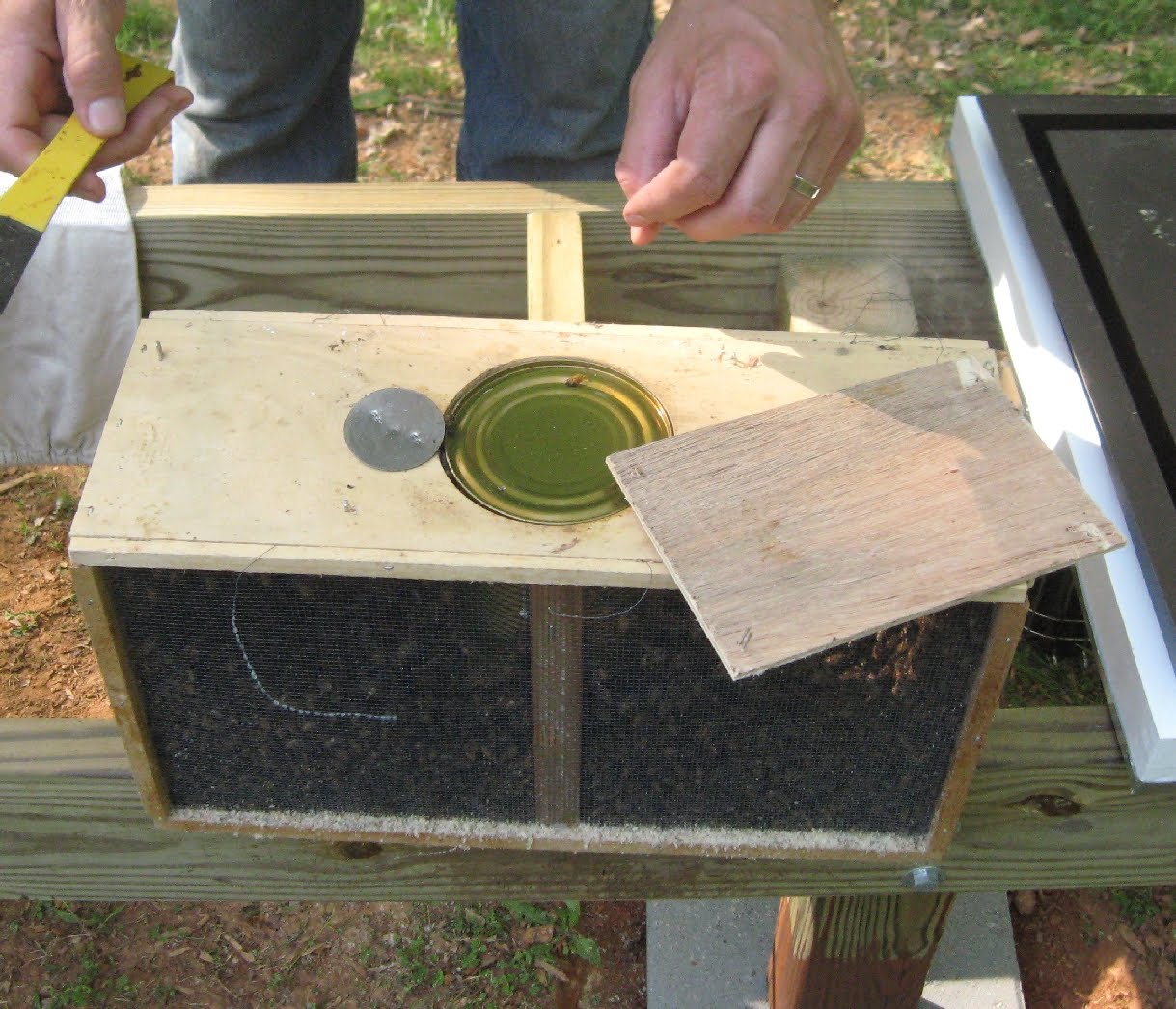
    This is the shipping box for the bees. The large can is filled with sugar syrup to feed the bees while they are in the box.  The small silver circle is a flange which is connected to the queen cage.  Before I remove either one, I spray the bees with a 1:1 sugar syrup. I also spray all of the frames with the same 1:1 sugar syrup solution. Then I tap the cage to knock the bees down to the bottom of the box.  After which I remove the queen cage and cover up the hole with the wooden plank.
    -
    Once removed the queen can be inspected.  There may be attendants with the queen or not.  In this case there is a handful but 2 are dead.  At this point the beek removes the cork covering the 'bee candy'.  The apiary these bees came from uses the tin disk that holds the queen cage in place instead.  So off comes the disk.
    -

    Now I punch a small hole through the bee candy.  This tells the bees they can free the queen by eating through the candy.  Some queen cages come with a nail attached.  My Wife lent me one of her sewing needles for this task.  Be careful not to stab any bees!
    -

    Now orient the cage so the top is up.  The top being the end with the bee candy.  Then attach a strip of wire or paper board to the side of the cagePaper board is what they make cereal boxes out of and just about everything else in a store that isn't wrapped in plastic (**Update** - use tin or plastic strips, or wire.  These bees chewed the paper board apart).  Make it an inch thick since the bees will be chewing on it.  Secure it to the cage with either a thumbtack or office staple. 
    -

    To hang the cage on a frame, again, use a thumbtack or office staple.  Remember candy end UP!.  the candy side is the exit out.  If it is facing the bottom and an attendant dies she will block the exit.  Then the queen will be trapped. Also make sure the screen is in a direction that will have better access to the other bees.  Perpendicular to the frames will do it. 
    -

    Now take the syrup can out of the big box and shake the bees into the hive directly over the queen cage.  Roll the box from side to side to get the bees out.  Then place the box by the front entrance so the few remaining bees can walk into the hive.  
    -
    When the bees slowly crawl up the frames toward the queen is a good sign.  If they quickly ball up around her is a sign of rejection.  This looks good.
    -

    After which I replace the outside frames and move all the frames back into the centered position.  Slowly!  Then I add the Hive Top Feeder filled with 1:1 sugar syrup medicated with Fumagilin.  I put on the inner cover & the telescoping cover.  Then reduce the size of the entrance.

    That's how I hived my 2010 Package!

    Tuesday, April 20, 2010

    DUCHESS'S CHRONICLE

    November 20, 10 - (Combined with Mary 11, 20, 10)
    (post link)
    r-SBB(c), DHB1, DHB2, IC, T-cover
    DHB1 = 10 frames, Plasticell foundation
    Brood Frames = 0/10
    DHB2 = 10 frames, Crimped-wire foundation
    Brood Frames = 0/10
    Queen spotted = yes, (no), didn't look
    Brood Present= yes, (no), didn't look
    Brood Pattern = solid, spotty, (n/a)
    Drone Cells = yes, (no
    ), didn't look
    Population = critical, low, (moderate), good, high
    Condensation = (none), minor, major
     
    Current Pests =SHB (4 found)
    • End of Duchess
    • Combined DHB2 with Mary
    • All extra bees shook into Mary
    • Removed SBB, DHB1, IC, VB, T-cover
    • All DHB1 frames into freezer 
    • SHB Found in DHB1

    November 13, 10
    (post link)
    r-SBB(c), DHB1, DHB2, HTF, VB, T-cover
    DHB1 = 10 frames, Plasticell foundation
    Brood Frames = 0/10
    DHB2 = 10 frames, Crimped-wire foundation
    Brood Frames = 0/10
    Queen spotted = yes, (no), didn't look
    Brood Present= yes, (no), didn't look
    Brood Pattern = solid, spotty, (n/a)
    Drone Cells = yes, (no
    ), didn't look
    Population = critical, low, moderate, (good), high
    Condensation = (none), minor, major
     
    Current Pests = ?
    • Possibly Queenless (post link)
    • Add Apistan Treatment
    • Remove HTF
    • Add IC
    • Insulate VB

    November 1, 10
    (post link)
    r-SBB(c), DHB1, DHB2, HTF, VB, T-cover
    • Mite Count (24 hour drop/sticky board) = 103

    October 24, 10
    (post link)
    r-SBB, DHB1, DHB2, HTF, VB, T-cover 
    DHB1 = 10 frames, Plasticell foundation
    Brood Frames = 1/10
    DHB2 = 10 frames, Crimped-wire foundation
    Brood Frames = 5/10
    Queen spotted = yes, (no), didn't look
    Brood Present= (yes), no, didn't look
    Brood Pattern = solid, (spotty), n/a
    Drone Cells = yes, (no
    ), didn't look
    Population = critical, low, moderate, (good), high
    Condensation = (none), minor, major
     
    Current Pests = None
    • Clean out SBB
    • Clean off Stand 
    • Cleaned off frame rests
    • Remove block reducer
    • Add Shim reducer
    • Add 1qt warm water to crystallized syrup in HTF
    • Close beneath SBB with luan board

    October 21, 10
    r-SBB, DHB1, DHB2, HTF, VB, T-cover 
    •  Add 1 gal of 'Fumagilin' 2:1 syrup - 1tbs ACV/gal

    October 14, 10
    r-SBB, DHB1, DHB2, HTF, VB, T-cover 
    •  Add 1 gal of 2:1 syrup - one Tbs apple cider vinegar/gal

    October 4, 10
    r-SBB, DHB1, DHB2, HTF, VB, T-cover 
    •  Add 1 gal of 2:1 syrup - one Tbs apple cider vinegar/gal

    September 27, 10
    r-SBB, DHB1, DHB2, HTF, VB, T-cover 
    •  Add 1 gal of 1:1 syrup - one Tbs apple cider vinegar/gal

    September 20, 10
    r-SBB, DHB1, DHB2, HTF, VB, T-cover 
    •  Add 1 gal of 1:1 syrup - one Tbs apple cider vinegar/gal

    September 13, 10
    r-SBB, DHB1, DHB2, HTF, VB, T-cover 
    •  Add 1 gal of 1:1 syrup - one Tbs apple cider vinegar/gal

    September 6, 10
    r-SBB, DHB1, DHB2, IC, VB, T-cover 
    DHB1 = 10 frames, Plasticell foundation
    Brood Frames = ?/10
    DHB2 = 10 frames, Crimped-wire foundation
    Brood Frames = ?/10
    Queen spotted = yes, no, (didn't look)
    Brood Present= (yes), no, didn't look
    Brood Pattern = (solid), spotty, n/a
    Drone Cells = (yes), no
    , didn't look
    Population = critical, low, moderate, (good), high
    Condensation = (none), minor, major
     
    Current Pests = None
    •  Remove Entrance Feeder (EF)
    • Add HTF
    • Remove IC
    • Add 1 gal of 1:1 syrup - one Tbs apple cider vinegar/gal
    • Remove Drone frame in DHB1
    • Add CW frame in DHB1

    May 31, 10
    (post link)
    r-SBB, DHB1, DHB2, HTF, VB, IC, T-cover 
    DHB1 = 10 frames, Plasticell foundation
    Brood Frames = 6/10
    DHB2 = 10 frames, Crimped-wire foundation
    Brood Frames = 2/10
    Queen spotted = (yes), no, didn't look
    Brood Present= (yes), no, didn't look
    Brood Pattern = (solid), spotty, n/a
    Drone Cells = (yes), no
    , didn't look
    Population = critical, low, (moderate), good, high
    Condensation = (none), minor, major
     
    Current Pests =Ants
    • Queen on frame # 7, DHB1 (Drone Frame)
    • Remove HTF
    • Add Entrance Feeder (EF) , 1 qt
    • Remove shim reducer
    • Add block reducer
    • Remove ant nest 

    May 25, 10
    (post link)
    SBB, DHB1, DHB2, HTF, VB, IC, T-cover
    DHB1 = 10 frames, Plasticell foundation
    DHB2 = 10 frames, Crimped-wire foundation
    Population = critical, low, (moderate), good, high
    Current Pests = Ants 
    • Clean dead ants from syrup in HTF
    • Found green mold on T-cover
    • Waxed mold spot on T-cover
    • Frames 5 & 6 in DHB2 drawn out

    May 16, 10
    SBB, DHB1, HTF, VB, IC, T-cover
    • Add 1 Deep Hive Body (DHB2)
    • Add 10 crimped-wire wax foundation frames
    • Sprayed frames with sugar syrup

    May 14, 10
    SBB, DHB1, HTF, VB, IC, T-cover
    Frames per box = 10

    DHB1 Foundation  = Plasticell
    Queen spotted = yes, (no), didn't look
    Brood Present= (yes), no, didn't look
    Brood Pattern = (solid), spotty, n/a
    Frames with Brood = 6/10, didn't look
    Drone Cells = (yes), no
    , didn't look
    Population = critical, low, (moderate), good, high
    Condensation = (none), minor, major
     
    Current Pests = None
    • All but 3 frames drawn out (1,9,10)
    • Some capped drone cells on Drone frame
    • Add 1 gallon of 1:1 syrup to HTF
    • Hatching workers on frame 5

    May 2, 10
    SBB, DHB1, HTF, VB, IC, T-cover
    • Add 1 gallon of 1:1 syrup 
    • Open bottom of SBB

    April 28, 10
    SBB(c), DHB1, HTF, VB, IC, T-cover
    Frames per box = 10

    DHB1 Foundation  = Plasticell
    Queen spotted = (yes), no, didn't look
    Brood Present= (yes), no, didn't look
    Brood Pattern = solid, spotty, (n/a)
    Frames with Brood = 2/10, didn't look
    Drone Cells = yes, (no
    ), didn't look
    Population = critical, low, (moderate), good, high
    Condensation = (none), minor, major
     
    Current Pests = None
    • Bees clustered on frames 4 - 7
    • Frames 4 - 7 mostly drawn out
    • Queen Released
    • Queen on frame 5
    • Eggs on frame 5 & 6
    • Drone frame partially drawn & filled with honey
    • Some capped honey on frame 4
    • Queen cage removed
    • 2 Supercedure cells on frame 6 
     
    April 27, 10
    SBB(c), DHB1, HTF, VB, IC, T-cover
    Frames per box = 10

    DHB1 Foundation  = Plasticell
    Queen spotted = yes, no, (didn't look)
    Brood Present= yes, no, (didn't look)
    Brood Pattern = solid, spotty, (n/a)
    Frames with Brood = 0/10, (didn't look)
    Drone Cells = yes, no
    , (didn't look)
    Population = critical, low, (moderate), good, high
    Condensation = (none), minor, major
     
    Current Pests = None
    • Gallon of medicated 1:1 syrup gone
    • Add 1/2 gallon regular 1:1 syrup to HTF

    April 20, 10
    (post link)
    SBB(c), DHB1, HTF, VB, IC, T-cover
    Frames per box = 10

    DHB1 Foundation  = Plasticell
    Queen spotted = (yes), no, didn't look
    Brood Present= yes, (no), didn't look
    Brood Pattern = solid, spotty, (n/a)
    Frames with Brood = 0/10
    Drone Cells = yes, (no)
    Population = critical, low, (moderate), good, high
    Condensation = (none), minor, major

    Current Pests = None
    • Installed 3lb package from Wilbanks Apiary, Georgia
    • Queen marked blue at Wilbanks
    • All Equipment new
    • 9 frames rewaxed Plasticell
    • Add one Pierco Drone frame
    • SBB closed on bottom
    • Feed with 1:1 syrup with Fumagilin & ACV, 1 gal
    • Hive on new stand
    • Entrance reduced
    Day One for this Colony