Showing posts with label Plasticell. Show all posts

Wednesday, April 20, 2011

Beginning to Worry

Here we are again at the start of another honey season and these bees have yet to draw out any honey comb.  This has been the biggest problem over the past several years.  I don't know what i'm doing wrong but something ain't right!

Today i looked at the honey supers to see a bunch of bees sitting around doing nothing.  The supers have been on for several weeks now.  Plenty of time to draw the comb out.  They just wont do it.  I've used Plasticell, Foundationless, and now Crimped wire.  I've sprayed the frames with sugar syrup and feed the bees with even more syrup.  I'm about at wits end.

At the moment the honey supers are foundationless.  Today i replaced 3 frames in each super.  One with 3 semi-drawn Plasticell frames and the other with 3 undrawn Crimped wire frames..  All frames were then sprayed with sugar syrup.

Wish me luck!

* ____________________________________________________________*

Monday, October 25, 2010

Inspection 10/24/10

Duchess
75 f
Sunny


It took longer than it should have but today i finally got into Duchess.  She has seemed more productive than the other two all year.  From her constant wax production to always having more bees flying at any given time.  If this colony can get through Winter than I hope for much honey from her next year.  She's more defensive than Myrina & Mary now that those two have been requeened.  Not at first but after going through a box of frames she can take to head butting.  She is in no way a problem fortunately.

OOPS! - She would have had her last gallon of treated syrup in her HTF today if I hadn't screwed up.  I made it Friday night the 22nd.  On Saturday I went to put it out but it had begun to crystallize already.  So I place the pot back on the burner and set it for medium heat.  I thought after ten or so minutes it would be back to all liquid and good to go.  Sadly I became distracted.  When I finally got back to it the syrup had been boiling for some time.  What a waste.  So I dumped the syrup out.  I had to now that it was toxic.  Four dollars worth of sugar and a teaspoon worth of Fumagilin-B.  I'm still mad at me.  What a dope!  I do not have enough Fumagilin left to make even a single extra gallon of syrup.  So Duchess will  not get her second gallon.  She's the only colony i have that's not had Nosema.  If one of them is going to get only a half dose than it's best to be her.

Ask me how well it worked come March?

Anyway the HTF did have the crystallized remains of the first gallon.  So, afterward, I added a quart of warm water to it.  Thirty minutes after the inspection was over the girls were flying in the typical sugar shock frenzy that follows the addition of syrup. 

Top Box Frames:
10. Full capped honey - 2010 CW
 9.  Full capped honey - 2010 CW
 8.  Full capped honey, back fill - 2010 CW
 7.  Full capped honey, back fill - 2010 CW
 6.  Full capped honey, back fill - 2010 CW
 5.  Full capped honey, some brood cells - 2010 CW
 4.  Full capped honey, some pollen - 2010 CW
 3.  Full capped honey - 2010 CW
 2.  Full capped honey - 2010 CW
 1.  Full capped honey - 2010 CW

Bottom Box Frames:
10. Drawn incomplete empty - 2010 Plasticell
 9.  Drawn incomplete empty - 2010 Plasticell
 8.  1/4 pollen - 2010 Plasticell
 7.  Minor pollen, depleted - 2010 CW
 6.  1/2 Brood - 2010 Plasticell
 5.  1/2 Brood, some pollen - 2010 Plasticell
 4.  1/2 Brood - 2010 Plasticell
 3.  1/2 Brood, Queen Cup - 2010 Plasticell
 2.  1/2 Brood, 1/4 pollen, 1/4 honey - 2010 Plasticell
 1.  Some honey, some pollen - 2010 Plasticell

I could not find the Queen.  I also didn't see any eggs since I forgot to put my glasses on before I started.  I did see some very young larva though.
-
 Extra wax, wrong place

Lots of bur comb on the top of the frames in the bottom box.  I scraped it all away including the propolis on the frame rests.  All the extra wax and still some of the Plasticell frames were unfinished.  They started out in the first box and yet, several of the outer frames were not drawn out completely.  The more I see the more I don't like it.  The Queen cup was well developed but nothing inside it.  
Frame 10, Initial hive box
-

I pulled the SBB and cleaned beneath the hive as well.  The same critters were under this hive as the others.  Wasps & spiders.  It's not a problem but after a whole season it builds up more than I had thought.  The Mud Wasps kept to the hive stand.  They were easy to remove.  The spiders had webbed up under the hive like there would be no tomorrow.
 Mud Wasps
-
 Many egg cases

The worst part of that being the type of spider.  Black Widows are docile creatures I have no problem with.  Except for the fact they could severely harm my kids; and mess me up too.  So she gets mashed every time i find her.  I thought the wood pile was bad but I've found more by the bees.
Charlotte
-

I previously mentioned the portables hive stands.  Nothing more than 4 pieces of wood screwed together.  Yet, they're great for keeping the bottom of a box off the ground; no grass, leaves, or smashed bees.  There never seems to be enough space on the regular stand so these are handy.  First they were used to move the hives to the new spot; 2 feet at a time.  Now they are a spot to put a top box while I'm in the lower box doing whatever.  There will be more uses in the future i'm sure.
Portable stand & quiet box
-

Last, we hit the high 30's this last week for nightly lows.  Frosts are coming.  So today I closed the SBB's in Myrina & Duchess.  Mary only has a solid BB.  I used a piece of luan cut to fit beneath Myrina's hive and slide into the back of Duchess's SBB.  Myrina's is a simple one I bought from Dadant.  Nothing fancy like rear access mite check boards.  So she had to bee lifted to put it on.  Duchess has a homemade one that does have the mite check board.  Her's slid into the back.  This leaves the main entrance as the bottom vent for Winter.  The vent boxes I use release the air up top.
*

Monday, October 11, 2010

Update

It's been awhile since I've updated.  The Summer has been terribly busy and the bees didn't really produce honey again so my motivations were elsewhere.  I kept up with the bees just didn't post about it here.  Nothing major happened so no critical information was lost.

The few things that did happened are:
* The 2010 Package has been named 'Duchess'.  We meant to name her after she showed some personality traits.  I like to name the bee queens after some human queen with the same personality. During the interim we took to calling her Duchess; like an heir apparent before naming.  After a while it just stuck.  Her personality is great.  Mostly calm and very productive.  On days where Mary & Myrina are sitting on their respective porches Duchess is always flying and bringing in the goods.  She was slow to kick out the drones but I thinks she's still on Georgia time.  We will soon be into Winter which will be her biggest test.

* I pulled out all the Pierco drone frames from the hives early.  They don't work well with me.  One needs to have two to fill a spot, not one.  As you pull one out it needs replaced by another.  It takes awhile before the bees can fully draw it out.  Meanwhile drone eggs are being laid in whatever good cells it has. The queen doesn't jump onto the frame the moment you install it either; it can take a few days.  Yet, you need to freeze it every twenty days regardless.  I never had more then a fist sized patch of capped brood on a frame going into the freezer.  Which caused me wonder how many honey making worker bees weren't produced all this time?  However, these frames would be great in a honey supper.  Bigger cells equals less wax which equals more honey.  So I'll cut down the frames to fit into a medium honey supper for next year.

* As mentioned above the harvest was pitiful.  Only three quarts of honey.  The bees never drew out the frames in the honey supers.  One super had been drawn out the year before.  What little honey was still in it from 2009 was to draw the bees into the super this year.  It sorta worked.  They filled it some more but there were few full frames.  I don't know what the issue is but we can not currently produce honey.  Maybe its the excluder or their temperament or the plasticell or I just suck as a beek!  I don't know.

* Done with Plasticell!  It has qualities I like but the bees in Mary & Myrina do not agree with me.  This year I pretreated each frame with a extra heavy coating of their own wax plus a thick sugar spray.  But the bees just wouldn't go for it.  Which drives me crazy.  When I started all of this they took to the Plasticell I put in their brood boxes.  It replaced the old black comb left in by the farmer.  Very frustrating.  I've gone to crimped-wire now.  I also treat it with the sugar spray.  One of the reasons i like the rigid foundation is for spinning survival.  We had honey the first year.  All of it fell apart during extraction.  Oh well.  I'll reinforce the crimped-wire with horizontal wire too.  Did I mention that Duchess (the 2010 package) couldn't care less about the foundation.  I put a post extraction super on her to clean it out.  After a week of rain I pulled it off.  She had begun to draw out all the frames!  Good little bees...

* I began feeding all three colonies in September.  I gave each if them a gallon of 1:1 each week.  It scared me the way they would put down the gallon in under 24 hours.  We had a significant dearth here to start with but the girls have bee doing well lately on whatever is out there.  The 1:1 helped them finish drawing out a few frames replaced in June.  Now into October they're getting a 2:1 syrup.  It is crystallizing before they can take the whole amount.  I'll need to do something about that.  Still I only feed once a week.  A 50 lb bag equals 2 feedings.  That gets expensive fast at several feeding a week.  I'll assist for now.  A check of their stores this week will help me gauge how to continue.

* Varroa mites have not been a problem either.  Last Winter beat up everybody.

That's all for now.
*

Saturday, May 15, 2010

Inspection 5/15/10

2010 Hived Package (Duchess)
82 f
Partly Sunny


There have been reports of Small Hive Beetle in the packages that many of us received back in April.  My neighbor found one in her new hive and has since taken measures to control it.  I went into the new hive today looking to see if I could find any; hoping I wouldn't.  I went through each frame and didn't see any.  But I missed the Queen as well, and she's marked,  so I'll continue to watch for them.

The Hive top feeder was about at the empty mark.  What little was left had a thin crystallized cap on it.  I didn't get to it earlier this week due to a bout with the flu.  Nothing too bad, just enough to keep me inside.  I'll refill the HTF and monitor it better this time.

Only about a cup of syrup is left under a sheet of rock candy

The brood nest has grown at a modest rate.  3 undrawn frames remain while the rest are filled with brood, pollen, & honey. The first frames to have comb have a spotty brood pattern look to them.  The latter drawn frames have a more contiguous pattern.  I'm sure that's just an issue with cell availability at the beginning of the hive. 


Check the bur comb on the Drone frame

  Frames:
  1. Undrawn
  2. 1/2 drawn. Eggs, pollen, capped honey
  3. Fully drawn. Mostly brood, lots of eggs and larva.  Pupae & Capped honey.  *Odd comb structure (the sheet not a cell)
  4. Fully drawn. Eggs & pupae
  5. Fully drawn. Eggs & mostly pupae. Some drone cells maybe.  hatching bees.
  6. Fully drawn. Pupae, capped honey, pollen 
  7. Done Frame - Fully drawn. Patch of pupae, some capped honey.  Mostly uncapped honey.
  8. 1/4 drawn. Capped honey.
  9. Undrawn
  10. Undrawn
None of the frames had been propolised together.  Very clean throughout the hive.  The colony looks good.  It may be time for me to add the next Deep hive body.  
 
Frame 5 where the Queen cage was hung
 
Above you can see a spotty brood pattern in the middle of the frame.  That is where the Queen cage hung during installation.  After which the bees filled the hole with comb.  So that area lags behind the rest of the frame.  Currently it has eggs, pollen, & honey in it.
 
 Pierco Drone Frame

These frames would be great in Honey suppers.  They hold more honey because there is less wax.  The cell size is much bigger than the other frames to fit the larger size of the drone bees.  The queen can tell what kind of egg to place in a cell by feeling the size of a cell with her front legs.  Therefore all the eggs laid in this frame will become drones.  This frame is noticeably heavier than the other frames.  

Odd thing is that these bees like to bur comb the plastic.  This is the only frame to have bur comb both on the top and the bottom.  Maybe they don't like the plastic.  I know I'm liking it less & less in the brood chambers, meaning the plasticell & the Pierco drone frame.  At Dadant's the other day all I bought was crimped-wire wax foundation.  

Bur comb on the bottom of the Hive top feeder

Can you guess where the plastic drone frame was?  I'm not yet sold on the notion of using a drone frame to reduce to number of Varroa mites.  Yes it works, i'm sure, but I'd rather have a frame producing thousands of bees than drones & mites.  And since the frame is to be frozen before the drones hatch, to kill the mites, the frame really doesn't produce anything at all for the hive.  It may be that I will take them out for now.  In the event of a mite infestation I could put them back in then.  In the meantime I can be producing lots of bees.

A question of Supersedure came up during the last inspection.  I could not find and Queen cups of Supersedure cells.  However, I didn't find the marked Queen either.  There are lots of new eggs on the outer frames though.  So I don't know what to say.  An experienced beek told me her packaged bees may have superseded after only 22 days in the hive!  So both of us are interested in what these girls do.  Hopefully I'll find the queen next week.
*

Thursday, April 29, 2010

Inspection 4/29/10

Mary
75 f
Sunny

At least she's consistent in her problems...

I took off the T-cover to look at the Hive Top Feeder.  It was about a quarter full of crystallized sugar.  All of that was dumped on the ground away from the hive.  The ants & dogs will appreciate that.  Though there were still some bees in the HTF working the candy.  It will be put away for now.  The nights are now in the 50's & 60's so the bees won't be clustering anymore.

Beneath the HTF was the brood nest in the deep hive box.  The population looked great.  Few of the bees stolen from Myrina are left.  They still make their presence known during inspections by becoming hyper-defensive.  The rest of the girls are Mary's.  They have 4 full frames of capped brood right now.  Unfortunately the brood pattern is spotty.  Which is a sign the Queen is weak.  I have already talked to a local queen breeder about buying one as soon as he has some.  Mary was weak all last year.  I didn't understand that until late Fall when it's too late to requeen.  Now is the time for that.

Another sign of a weak queen is chalk brood.  Which i found several cells worth in the middle of the nest.  I knew it would happen.  That's why I talked to that queen breeder 2 months ago.  But I must say for a fading Queen Mary is doing better than expected.  If she can keep it going for a little while longer she'll have done her part.  After which with the new Queen the spotty brood & chalk brood will go away.

Speaking of which Queen Mary was found on frame 5 milling about.  I meant to mark her today but forgot to borrow the marking pen from my neighbor; now a new beekeeper herself.  I mark her next time.

I have been wondering how the bees will handle making drone cells on Plasticell.  It's cell size is smaller than drone cell but not by much.  Mary's girls made some drone cells on the bottom of 1 frame; not unusual.  However, they half attached it to the imprinted Plasticell foundation & half on the wood frame.  That way they could make it that little bit bigger that they needed.  I've not yet found any drone cells in the middle of the frame.  I'm thinking they won't but am waiting to find out. 

Also on the bottom of the frames I found a few Queen cups.  These differ from the queen cups in the New Hive due to their location on the frame.  Queen cups on the bottom of the frame would become Swarm cells.  When a Swarm cell hatches the OLD queen takes half the colony and leaves the hive for good.  They then setup shop elsewhere as a new colony.  The New queen from the swarm cell stays in the original hive to carry on the where the Old queen left off.  Not enough space in the hive is one reason for a colony to swarm.  This may be a indicator that this hive needs another deep hive box put on the hive.  With extra room for brood the colony will be less likely to swarm.  So I'll put another brood box on this hive this week, as soon as it's painted.

Finishing the inspection had a slight bump.  Without the HTF i need to put the Inner Cover on.  I don't have one I'd use.  Mary's old one from fall was puled off when I moved her back outside.  It was plastered with crystallized sugar & Nosema droppings.  The leaking syrup also warped the cover.  I'd rather burn it than use it.  For now I'll leave the HTF on but with water in it.  What rock sugar i couldn't knock out will sweeten the water.  I'll make another IC this week and put it on next weekend.

To review:
Spotty brood & chalk brood.
She needs a DHB and a IC.
Oh...and a new Queen!

Wednesday, April 21, 2010

Package & Installation

The Queen cage is a small cage containing the Queen and sometimes several attendants.  It is used to ship the Queen either individually or as part of a 'Package'.  

Typically, there is a small hole at the end of the queen-cage for the queen to exit by.  It is plugged with a cork on the outside.  It leads into a larger hole filled with a bee candy stopper (corn syrup & sugar).  The queen is trapped in a compartment on the other side of the bee candy.

To release the queen I remove the cork exposing the candy.  Then set the queen cage into the hive between 2 frames.  After which the bees are added separately.  The bees eat through the candy.  Which in turn releases the queen.

While the queen is waiting to be released the bees feed her through the screen.  This process gives the bees time to acclimate to the presence of their future queen.  Otherwise they could reject her.
---   ---   ---

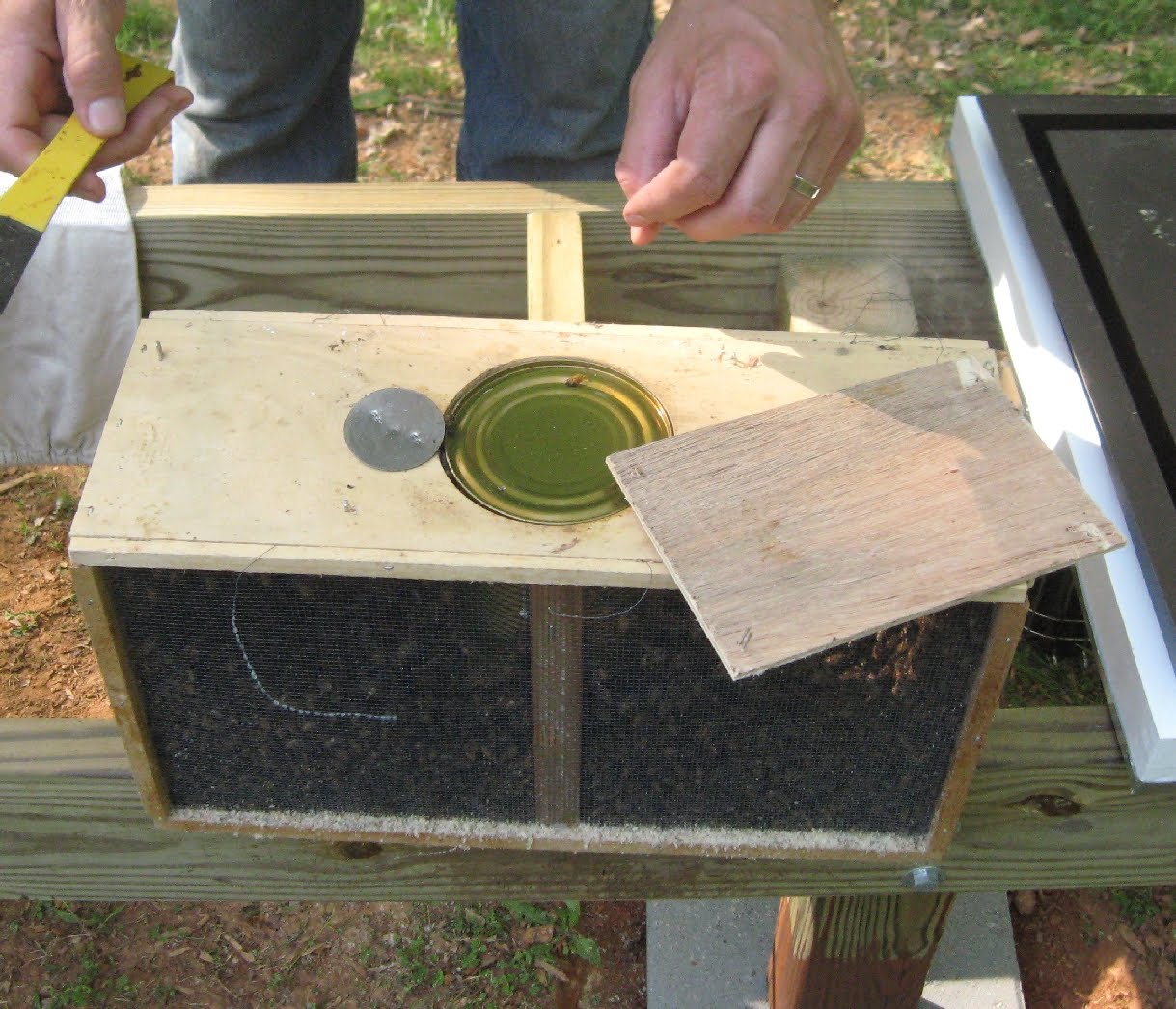
This is the shipping box for the bees. The large can is filled with sugar syrup to feed the bees while they are in the box.  The small silver circle is a flange which is connected to the queen cage.  Before I remove either one, I spray the bees with a 1:1 sugar syrup. I also spray all of the frames with the same 1:1 sugar syrup solution. Then I tap the cage to knock the bees down to the bottom of the box.  After which I remove the queen cage and cover up the hole with the wooden plank.
-
Once removed the queen can be inspected.  There may be attendants with the queen or not.  In this case there is a handful but 2 are dead.  At this point the beek removes the cork covering the 'bee candy'.  The apiary these bees came from uses the tin disk that holds the queen cage in place instead.  So off comes the disk.
-

Now I punch a small hole through the bee candy.  This tells the bees they can free the queen by eating through the candy.  Some queen cages come with a nail attached.  My Wife lent me one of her sewing needles for this task.  Be careful not to stab any bees!
-

Now orient the cage so the top is up.  The top being the end with the bee candy.  Then attach a strip of wire or paper board to the side of the cagePaper board is what they make cereal boxes out of and just about everything else in a store that isn't wrapped in plastic (**Update** - use tin or plastic strips, or wire.  These bees chewed the paper board apart).  Make it an inch thick since the bees will be chewing on it.  Secure it to the cage with either a thumbtack or office staple. 
-

To hang the cage on a frame, again, use a thumbtack or office staple.  Remember candy end UP!.  the candy side is the exit out.  If it is facing the bottom and an attendant dies she will block the exit.  Then the queen will be trapped. Also make sure the screen is in a direction that will have better access to the other bees.  Perpendicular to the frames will do it. 
-

Now take the syrup can out of the big box and shake the bees into the hive directly over the queen cage.  Roll the box from side to side to get the bees out.  Then place the box by the front entrance so the few remaining bees can walk into the hive.  
-
When the bees slowly crawl up the frames toward the queen is a good sign.  If they quickly ball up around her is a sign of rejection.  This looks good.
-

After which I replace the outside frames and move all the frames back into the centered position.  Slowly!  Then I add the Hive Top Feeder filled with 1:1 sugar syrup medicated with Fumagilin.  I put on the inner cover & the telescoping cover.  Then reduce the size of the entrance.

That's how I hived my 2010 Package!

Thursday, April 15, 2010

Inspection 4/15/10

Myrina
75 f
Sunny

***A special Thanks to Sherry who found the queen for marking and is planing to hive her first package of bees next week.  A round of applause for my awesome neighbor and new beekeeper***
_ _ _      _ _ _
3 reasons for going into Myrina today:
  1. To mark the queen
  2. To check the drone frame
  3. To look for swarm cells
And to clarify the brood boxes:
  1. Current top box = Old frames with old, dark, natural comb
  2. Current bottom box = Newer Plasticell frames, mostly drawn out
The bees Winter cluster was in the box with the Plasticell frames.
_ _ _          _ _ _           _ _ _

Upon taking off the cover I found a colony of small black ants on the inner cover.  There were different sized ants & a winged one or two.

 HEY! we're zoned for a single family home.  No duplexes!

They didn't like me letting the light in and they really didn't like me dumping them on the ground.  I'm sure they were attracted to the sugar in the HTF; it has crystallized.  So I removed the HTF.  I'll clean it and have it ready to use for the package that arrives on Saturday.

Looking through the frames was alright.  5 frames in the top box have brood, 3 in the bottom box.  Queen Myrina was on frame 5.  The brood patterns look spotty right now.  The forum people say reversing the brood boxes was stressful to the bees.  They also say wait a week or two and the pattern should be back in good order.  So Ill be watching that and reading up on reversing brood boxes.

The marking went quickly & easily. I used the little plunger tool Dadant sells. Worked great. When I put it over her she climbed up into it. Then the plunger immobilized her while I marked her with the pen.  It only took a few seconds.  A light touch of the tip to her back and a small drop plopped out.  Yet more paint came out than I wanted; a single drop goes a long way apparently.

-The image below shows how a very small drop can cover the Queen's entire back-


Myrina Unmarked
-

It's light blue when there's no Sun glare

The president of our bee club recently lost a queen to marking paint.  He used an older pen.  He said when he marked her a pool of paint came out and completely covered her.  The blob of paint killed her quickly.  Heeding his warning I was as careful as possible.

 Ideally Myrina should be requeened  later this year.  This will make it much easier to find her when that time comes.
-
Checking the drone frame was easy too.  They hadn't touched it.  It had been placed on the edge of the brood nest before I reversed the boxes.  Since then the bees have moved back up into the new top box.  The brood in the now lower box are hatching out but the queen isn't laying down there.  So the drone frame hasn't had any attention placed on it.

I replace it with another drone frame that had been rewaxed.  I didn't think about it at the time but I should have put the new frame next to the active brood nest.  Instead I put it back where the old one was.  The queen is laying plenty of drones in the bottom corners of the frames in the top box.  
I have yet to find any drone cells made on the Plasticell frames.  So far they're all in the natural comb frames.  I'm curious to see if they will do that or not.
-
I really don't want to see any swarm cells right now.  I have one good colony, Myrina, one weak colony, Mary, and a package on the way.  Which means Myrina is the only colony that can make surplus honey for me this year.  If she swarms there won't be any honey for us.

Fortunately I didn't see any in this inspection.  If they do make some I'll toss them in the nuc.  I can use them to requeen Myrina and maybe the other colonies too later this year.  It was a very hard Winter so populations are down.  I feel it will be awhile before swarm cells pop up.  We see...
-
Hive-wise I'm still trying to change out the old frames with new ones.  Last year was a bust since the bees weren't making much comb.  I removed 2 old frames from the sides of the top box & added 2 new rewaxed Plasticell frames.  I also replaced an undrawn Plasticell frame, from last year, with a new rewaxed Plasticell frame in the bottom box.

Thursday, April 1, 2010

Inspection 4/1/10

Mary
81 f
Sunny

Long Live the Queen...She pulled it off! Mary lives for another season!

I opened up Mary today to see how she's doing. They have taken about half of the medicated syrup. It has begun to crystallize on the surface. Pulling off the HTF showed the still messy frames from where the Nosema caused problems. The bees where testy and did not like the intrusion. Many are from Myrina who is normally defensive. It is really a sign of how stressed they are having such a weak Queen. I used my smoker a lot.

I went through all the frames in the single deep hive. 1 through 3 were mostly honey, some old pollen, & emptied cells. Frame 4 was the same on the outside. The inside was half capped brood & fresh maple pollen. There was also a good showing of eggs and larva. Frame 5 was also half capped brood & fresh pollen but on both sides. I found Mary herself slowly walking around on the outside of 5. She was looking for a cell to lay in. I watched for a moment hoping to see her lay an egg. But then gave up thinking I may be hindering her. Frames 6 through 10 were again mostly honey, some old pollen, & emptied cells.

So, the brood nest is small. Oddly the pollen was being stored beneath the brood on the frames. I believe that is a result of the colder 30's & 40's night time temps. Again she is only in a single deep right now. However the temperatures here have finally broke. Night time temps are now in the 50's and up. The bees are now free to go anywhere they want in the hive. The brood pattern was beautiful; almost complete with very few holes.

I removed the SBB so to clean the dried sugar off it. It was replace with an unused BB that was meant for the new hive for the up-coming package. Inspection of the wood beneath the SBB showed the Nosema has gone away. It has been in place for 10 days. I saw no stain from the Nosema. The Fumagilin did it's job. I'll leave the HTF on for another week or two. Myrina's bees (they get all the credit) have done a great job cleaning up the cells. Rotten pollen, Chalkbrood mummies, & wax moth debris had been pulled from the frames. Now I hope they can start making some new wax.

The hive body itself was in terrible shape. It was very dirty from the Nosema & the dry sugar. I will consider whether to replace the wooden ware or not. Two frames did need replacing now. The top bar had split from the side rails. Frame 3 & 5. 5 has brood so it will stay in the hive for now. Frame 3 came out. Replaced by another honey filled deep frame. It was salvaged from Mary's second deep body removed in November due to Wax Moth. All of the frames in this deep came assembled from Dadant. They apparently didn't use glue. I was surprised to see the side staple pull out. Something else I'll need to fix.

About the brood. I did not see any Drone cells. I did see them when Myrina had only a little brood. All the frames are Plasticell. I don't know how much of an effect that will have. The cell size is standard not small cell. Curious to be sure. Mary, though, may not yet be in the mood to make drones yet. I'll check again next weekend.

She's still in the temporary location. I'm second guessing where to place ALL my hives. Wherever they end up will be decided soon. Before the package arrives.

I'm sorry for not taking any pictures this time. I was in a hurry.

Monday, March 29, 2010

Waxing Plasticell Foundation

My first year of beekeeping introduced me to Wax Moth & disintegrating comb in the extractor. Since then all new frames are made up of Plasticell. Well, bees don't really like plastic foundation so the manufacturer coats it in beeswax. Nice but the bees are still somewhat hesitant about using it. They will draw it out but only when they have no choice. That can take all season in some cases.

I want the bees to draw out the frames faster than that so I'm adding some incentive. More beeswax. I have a little West Bend hot pot that works great for directly melting wax. It has a basic temperature set dial. Medium heat gives the best results. Quick to melt but no boiling or spitting.

I use a foam brush for the application. It soaks up enough hot wax to stay liquefied for up to half of one side of a deep frame. Though, 3 brushings are necessary to properly cover one side. It's a simple process, melt the wax, dip the brush, shake off the extra, paint the wax onto the frame, mash it in as it firms up. Also, no mess if you use paper towels or cardboard. I did it in the kitchen without getting a drop on the floor.

Top- Pierco Drone frame / Bottom- Plasticell Deep

This process eats through the wax in a hurry though. I've never worked toward producing wax and I've only been beeking for 2 years. There are 20 Deep frames that need done. I don't have much wax on hand but hopefully there might be enough to finish the job. Otherwise I'll have to drop 10 & punt.

Unfortunately the Pierco Drone Frame did not like the heat. It began to warp as I waxed it. It looked like it might not work but after it cooled off again, much later, the shape went back to normal. The Plasticell Foundation had no reaction to the heat. It never warped at all.

Before Waxing
-
After Waxing

I wonder if adding some essential oils might induce to bees to draw it out faster yet. Many Beeks use the essential oils. I worry about disturbing the pheromones already in the hive with foreign scents. I'll need to read more on that. This will be the first time I've tried this so I won't know if it works until mid-season. The Packaged bees will start out on the Plasticell so won't have a choice. When Mary gets her second DHB back filled with the double waxed foundation I will get a better idea.