Showing posts with label Fumagilin-b. Show all posts

Wednesday, October 19, 2011

Fumagilin & Screened Bottom Boards

Today the colonies received their last treatment of Fumagilin.  Fumagilin-b is an antibiotic that controls the disease Nosema, or bee dysentery.  The disease usually occurs during Winter while the bees are unable to release bodily waste each day.  The weather is too cold for the bees to fly outside to relieve themselves.  So they stay in the cluster and must hold it in for months sometimes.  If they get Nosema the bees can no longer hold it in and can make a big mess inside the hive.  Plus the stress of the disease can weaken the colony and lead to it's demise. 

In Fall each full hive gets 2 gallons of medicated syrup per twenty frames.  Last week they all got their first gallon.  Two colonies were given only one gallon since they are only ten frames in size; Myrina & Nuc #5.  The Fumagilin is put in a heavy sugar syrup, 2:1 sugar to water.  That's eight pounds of sugar in about two quarts of water.

Crystallized sugar after one gallon of 2:1 syrup
This time of year the bees will take it down in one to two days.  There is some crystallization of the sugar in the Hive Top Feeder.  To fix that i toss a quart of warm water into the feeder afterward.  It dissolves the sugar and the bees then take it down too.

Also it's time to close all the Screened Bottom Boards (SBB).  Some beeks leave them open but i close mine.  I think it helps the bees brood lower in the hive.  Slatted Racks aid that as well.  Myrina's SBB was replaced with a regular BB with a solid bottom.  Mary & Nuc #5 also have the solid BB now.  Heléna & Melissa both have the closed off SBB.  As does that little September swarm i haven't been talking about.

The next steps toward Winterization will be the final Varroa check & treatment if necessary.

*_____________________________☼______________________________*

Tuesday, October 18, 2011

Hive Inspection 10/17/11

NUC #5
Sunny
75°F

The only nuc i have left and the first one i have ever tried to take through Winter.  She is from a wild hive and may be Survivor bees.  They have about finished their one gallon of 2:1 syrup medicated with Fumagilin.  Since they are a nuc that's all they get.

Top Box DNB2: frames
1 - Backfill, honey, empty
2 - Mostly drawn, backfill, SHB (1)
3 - Mostly drawn, backfill
4 - Backfill, honey, SHB (1)
5 - Mostly drawn, honey, backfill

Bottom Box DNB1: frames

1 - Solid Honey
2 - Honey, backfill, brood, pollen
3 - Honey, backfill, brood (eggs) - QUEEN (marked)
4 - Honey, backfill, brood
5 - Honey, brood, pollen, backfill


Bees on all the frames of the bottom box
Population seems to only be fair.  I'd like to see more bees in here.  They have four frames with brood and that's a good thing.  Honey stores could be higher too.  There are a couple of feedings left so hopefully that will do it. 

Queen of Nuc #5 (Mab).  Sorry for the blurry pict
At least these bees know to move the brood nest to the bottom box.  I wont have to manually move them down like the others.  I will also need to insulate this nuc and get a HTF for warm weather feeding.

*_____________________________☼______________________________*

Saturday, October 15, 2011

Hive Inspection 10/15/2011

MARY & MYRINA
Sunny
67°F
Slight Breeze

Mid-October is the traditional time for final inspections before Winter.  Both colonies have received one gallon of 2:1 syrup medicated with Fumagilin.  The second gallon will be fed to them in the next day or two.

Starting with Mary.  Last inspection she had little brood and i never saw the queen.  After checking records I learned i have no record of seeing Mary at all this year. 

Top Box DHB2: frames
1 - Solid honey
2 - Solid honey
3 - Honey & brood (eggs)
4 - Honey & brood (eggs)
5 - Brood & honey (eggs) - QUEEN (unmarked!)
6 - Backfill & pollen
7 - Backfill & pollen
8 - Backfill & pollen
9 - Backfill & pollen
10 - Solid honey

Bottom Box DHB1: frames

1 - Honey & backfill
2 - Honey & backfill
3 - Honey, pollen, backfill
4 - Pollen, backfill, brood
5 - Pollen & backfill
6 - Backfill - most
7 - Pollen, backfill, honey - most
8 - Honey & backfill - most
9 - Honey - most
10 - Honey - most

Three weeks ago this colony had nine brood frames.  Now it has only four.  The brood frames it does have are beautiful with solid laying patterns.  Brood production always falls off at the end of the year.  Usually the Queen completely stops laying eggs around mid-December.  It may be that these bees have slowed down a little early but the last week has been cool and solid rain.  The nightly lows have also been in the high forties since the first of October.  Which might lessen the queen's urge to lay, maybe.  The population is good but not high.  I would have liked to see more bees in this colony.

Bees on every frame of the top box
 Long live the Queen.  We found her walking around frame #3 in the Top box; and she was unmarked to boot!  I thought this colony had requeened in Spring but i could not find anything in the records about it.  The last entry involving Queen Mary Actual was last year and stated she was marked blue.  So my record keeping needs some honing. This pretty Queen was treated to a quick marking with white paint and released.

2011's Queen Mary about to be marked
 The bees are nicely backfilling the brood nest.  One or two more feedings should top them off.  They are still up in the top box.  I hope they plan to move down to the bottom box soon.  Last year one of the colonies Wintered in the top box and did fine.

Backfilling the Brood nest
- - -   - - -   - - -

Myrina was a surprise.  Her population is in the tank.  SHB all over the place.  Only as much stores as so few bees can muster.  She couldn't even finish off her Fumagilin syrup before it crystallized.  What a mess.

Top Box DHB2: frames
1 - Backfill & fresh brood (eggs)
2 - Backfill, pollen, honey, brood
3 - Honey & backfill
4 - Honey, backfill, pollen
5 - Backfill, honey, SHB (10)
6 - 1/2 Backfilled
7 - empty
8 - Mostly backfilled
9 - Empty & SHB
10 - Mostly backfilled

Bottom Box DHB1: frames
1 - Pollen & backfill
2 - Brood, backfill, pollen - QUEEN (marked white)
3 - Backfill & pollen (dropped & placed in 4th position)
4 - Backfill & pollen (placed in 3rd position)
5 - Some pollen
6 - empty
7 - empty
8 - empty
9 - empty
10 - empty

Whoa!  Not at all what one wants to see at this time of year.  This is the first time since i got Myrina in 2008 that she isn't the strongest colony.  In fact she's a wreck.  I had to add two more SHB traps for now.

Choices are few but at least we have some.  To address her small population she will be broken down to a single Deep box.  A better fit there will help her deal with the cold Winter temps.  It will also help her control the Small Hive Beetles.  If her population is big enough i can add a Medium Honey Supper filled with honey.  Then they would be in great shape going into Winter.  I hope to do all of this tomorrow.  Plus I'll add a regular Bottom Board to replace the Screened one she has now. 

I could also combine the extra swarm into her.  That would boost the population but not by the amount she needs to stay in the Double Deep.  I'll have to think that over some more first.

For what it's Worth, there were no drone cells on any of the frames i saw today.  That's the first time that's happened going into this Winter.

*_____________________________☼______________________________*

Saturday, May 7, 2011

Heléna - the Forth Hive

The Package showed up on Thursday the 5th.  Today they were hived without any problems.  The bees seem to have accepted their new queen.  She came unmarked.  I'll mark her in a few weeks after they've settled in.  for now the bees are taking to the hive well enough.  They were making orientation flights as soon as i poured then into the hive.

Heléna being Hived
It would have been better to hive them tomorrow but rain is in the forecast.  These bees were starved though.  When I poured the syrup into the HTF they all but swarmed the syrup.  It took a few minutes to get the bees out of the HTF just to close it.

Typically one is supposed to feed the bees Fumagilin at this stage to fend off Nosema (dysentery).  I want to back away from all these chemical treatments so i didn't.  They had Apple Cider Vinegar and Thyme oil added to the syrup instead.  Those will help with both Nosema & Varroa without being too harsh.  If i don't see any signs of Nosema I'll not use the Fumagilin at all.  So far no colony has been given any this year.

This hive is all foundationless.  They should draw it out faster so they will have brood sooner, so everyone tells me anyhow. 

* ____________________________________________________________*

Thursday, October 21, 2010

Feeding Fumagilin-B

Today the bees woke up with their HTFs filled with Fumagilin-B 2:1 syrup.  They will all get 2 gallons each.  I checked them today at lunch.  All three seemed to be flying about in the typical sugar shock way.  I could see Myrina's girls were drinking it up after i opened her cover.  I didn't open up Mary or Duchess because the bees started to dive bomb me.  I'll check on then tonight after work.

The problem I had last night when I put the syrup out was the bees had propolised the inside of the HTF closed.  I didn't see it at first and had to fix it after the syrup had been poured in.  The HTF had been without syrup in it for a few days and I guess the bees did their thing.  Another lesson there.

Sugar issues.  It's too expensive to feed the girls constantly.  They've been getting a gallon a week so far.  Their stores are OK in all the hives; I'll check Duchess this weekend.  The less I feed the better.  The problem is the impurities in the sugar.  Some liquid had gotten into the sugar and made dried globs.  These globs didn't dissolved like regular sugar.  Even after 6 hours it hadn't all melted.  There were still chunks when i put it in the HTF.  When I checked today they were finally gone.  I'm buying the cheapest sugar I can find ($0.57/lb).  These off brands apparently have their own hidden cost!
*

Wednesday, April 28, 2010

Inspection 4/28/10

New Hive (Duchess)
71 f
Partly Sunny

They finished their first gallon of 1:1 medicated syrup the previous day.  I added another 1/2 gallon of unmedicated then, yesterday evening.  There were a handful of drowned bees in the HTF then but none today.  I check each day now to see how fast they're taking it. 

Once the HTF was off I was able to see that the bees were working in frames 4 through 7.  I pulled the cage frame and saw the Queen had been released.  They had not built too much comb around the cage.  It came out with only a small tug.  The rest of the frame had been mostly drawn out & somewhat filled with pollen & syrup or nectar.

Bees working 4 through 7
(click to enlarge)
-

Almost capped syrup at the top

Frames 4 through 7 were close to being completely drawn out.  Beautiful white wax.  They had also capped a small patch of syrup on frame 4.  The frames were a mix of new wax & old wax.  The bees used the old wax from the rewaxing effort to build the comb down on the lower half of the frames.

Frames 5 & 6 is where the eggs were at.  Closer to the top of the frames mostly.  There was also pollen & syrup on the ends.  The bees obscured the view but I'll say half of the typical brood nest area had eggs on each frame.  The Queen was on frame 5.  Busily laying eggs.  She looks OK and the workers are taking care of her.

Queen & eggs

Frame 7 is the Drone frame.  It has been partially drawn out but the queen has not got to it yet.  In the meantime the bees are storing some syrup on it.  I'd love to use these drone frames in the honey suppers.  The cells are much bigger than normal brood cells.  So more space would be dedicated to honey than comb wall.

On frame 6 there was 2 Queen cups.   At first I thought they were Supercedure cells.  Since then I have learned that they are only 'Cups'.  The bees regularly construct Queen cups.  So if something happens to the Queen they can quickly form a emergency Queen cell.  As much as they are always making these they are also tearing them down.  So there should always be some somewhere in the hive.  I mentioned this to one of the Bee club leaders.  They thought the stress of being shipped was enough to cause the bees to make these so soon.  As of now it doesn't seem to mean anything is wrong with the colony.  I'll be watching for any other signs though.

Queen cup.  Currently filled with pollen

The colony is looking good.  They are building up the comb & population.  They may need another hive body in the next week or two.  She doesn't have a name yet because it's too early to know what she's like.  It'll be 45 days, or so, until all the bees are daughters of the Queen.  Then I can get a good idea of what the colonies personality is going to be like.  I'd settle for calm & productive, but who wouldn't.

    Wednesday, April 21, 2010

    Package & Installation

    The Queen cage is a small cage containing the Queen and sometimes several attendants.  It is used to ship the Queen either individually or as part of a 'Package'.  

    Typically, there is a small hole at the end of the queen-cage for the queen to exit by.  It is plugged with a cork on the outside.  It leads into a larger hole filled with a bee candy stopper (corn syrup & sugar).  The queen is trapped in a compartment on the other side of the bee candy.

    To release the queen I remove the cork exposing the candy.  Then set the queen cage into the hive between 2 frames.  After which the bees are added separately.  The bees eat through the candy.  Which in turn releases the queen.

    While the queen is waiting to be released the bees feed her through the screen.  This process gives the bees time to acclimate to the presence of their future queen.  Otherwise they could reject her.
    ---   ---   ---

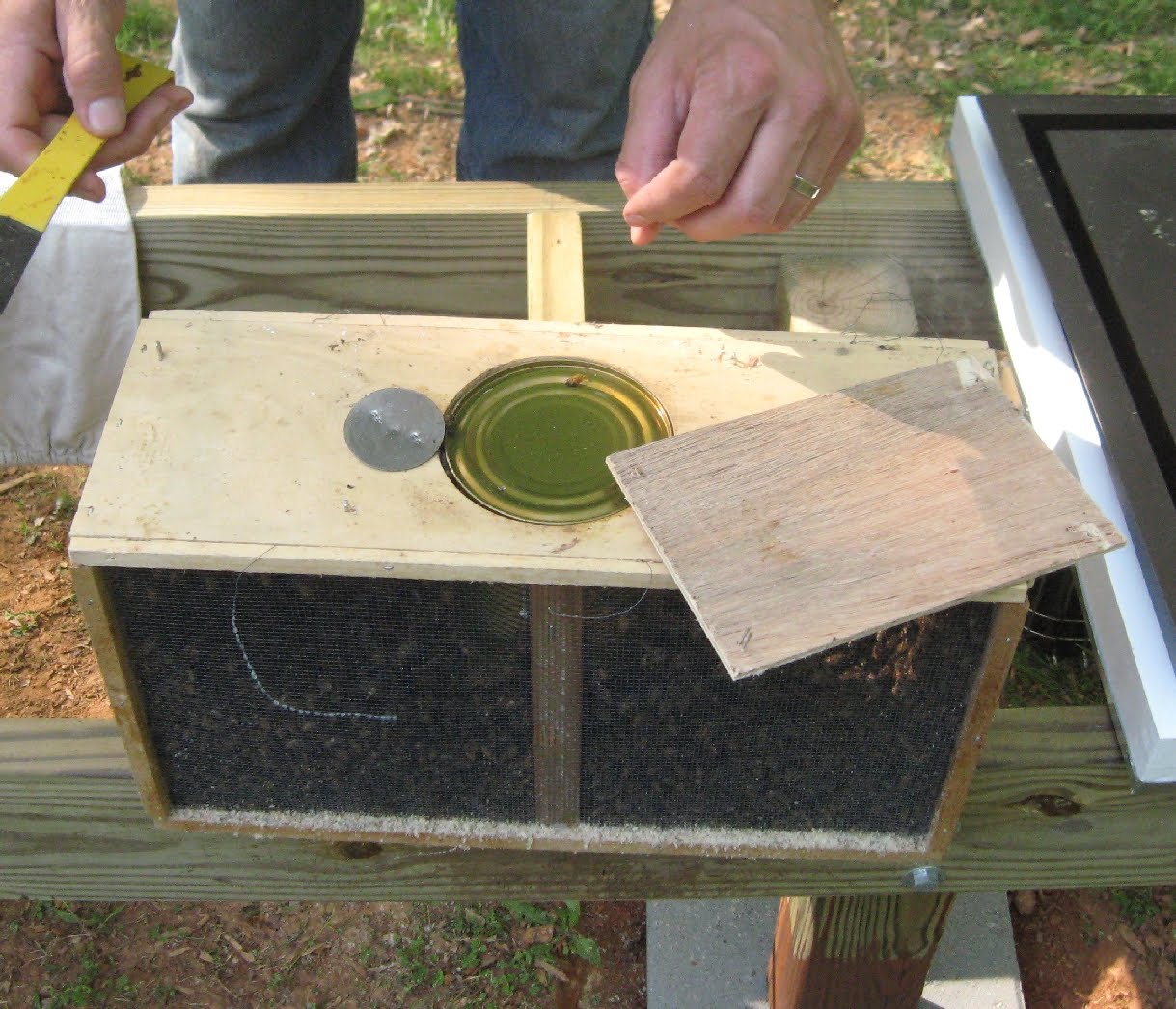
    This is the shipping box for the bees. The large can is filled with sugar syrup to feed the bees while they are in the box.  The small silver circle is a flange which is connected to the queen cage.  Before I remove either one, I spray the bees with a 1:1 sugar syrup. I also spray all of the frames with the same 1:1 sugar syrup solution. Then I tap the cage to knock the bees down to the bottom of the box.  After which I remove the queen cage and cover up the hole with the wooden plank.
    -
    Once removed the queen can be inspected.  There may be attendants with the queen or not.  In this case there is a handful but 2 are dead.  At this point the beek removes the cork covering the 'bee candy'.  The apiary these bees came from uses the tin disk that holds the queen cage in place instead.  So off comes the disk.
    -

    Now I punch a small hole through the bee candy.  This tells the bees they can free the queen by eating through the candy.  Some queen cages come with a nail attached.  My Wife lent me one of her sewing needles for this task.  Be careful not to stab any bees!
    -

    Now orient the cage so the top is up.  The top being the end with the bee candy.  Then attach a strip of wire or paper board to the side of the cagePaper board is what they make cereal boxes out of and just about everything else in a store that isn't wrapped in plastic (**Update** - use tin or plastic strips, or wire.  These bees chewed the paper board apart).  Make it an inch thick since the bees will be chewing on it.  Secure it to the cage with either a thumbtack or office staple. 
    -

    To hang the cage on a frame, again, use a thumbtack or office staple.  Remember candy end UP!.  the candy side is the exit out.  If it is facing the bottom and an attendant dies she will block the exit.  Then the queen will be trapped. Also make sure the screen is in a direction that will have better access to the other bees.  Perpendicular to the frames will do it. 
    -

    Now take the syrup can out of the big box and shake the bees into the hive directly over the queen cage.  Roll the box from side to side to get the bees out.  Then place the box by the front entrance so the few remaining bees can walk into the hive.  
    -
    When the bees slowly crawl up the frames toward the queen is a good sign.  If they quickly ball up around her is a sign of rejection.  This looks good.
    -

    After which I replace the outside frames and move all the frames back into the centered position.  Slowly!  Then I add the Hive Top Feeder filled with 1:1 sugar syrup medicated with Fumagilin.  I put on the inner cover & the telescoping cover.  Then reduce the size of the entrance.

    That's how I hived my 2010 Package!

    Tuesday, April 20, 2010

    Hived the Package Today

    We started out this morning by hiving my neighbor's package in her Bee yard.  We did everything that was shown to us at the club demo.  Her bees look good and all seems well.

    Afterward I got ready to repeat the task over in my yard.  The new package (Duchess) was a good impetus for making a new hive stand.  I put it in a new spot too.  The placement of the first 2 hives was poor. This new spot has lots more Sun and is better drained. The stand is 8 feet long and is 20 inches tall and will hold all 3 hives.  The package will be the first colony on it.  I'll move the other 2 over to it in the next month.  It has room for a fourth hive too. Maybe I'll catch a swarm or start a queen nuc or something.   Once all 3 hives are on the new stand I get rid of farmer Bob's old rickety stand.


     Myrina on the Old Stand in the background

    It was great to put all the new hive parts together on the new stand.  It's clean with fresh paint.  The newest house on the block.  I'm still updating Mary's & Myrina's equipment.  Frames are the slowest to update.  I can only take so many in a season.

     I'm trying the Drone frames this year

    Once all the equipment was down by the new hive I opened up the package.  The Queen cage was missing it's cork over the candy but no big deal.  This hole was covered by a piece of metal anyway.  There was some wax being built up on the cage & syrup can but very minor.  The Queen looked good but 2 of her 5 attendants had died.  I attached her between the 2 middle frames and poured in the bees.

    Queen (soon to be named)

    The bees clumped out quickly and many took to flying around the hive.  The rest slowly crawled up the foundation toward the queen.  They seem to like her as there was no balling.  I put the hive back together and added a gallon of 1:1 syrup, with Fumagilin and apple cider vinegar, into the hive top feeder.  Once closed up the bees stayed close to the reduced entrance.  After an hour I checked on them and saw what looked like Orientation flights by many of the bees.  Lots of good signs.

     Before
    -
    After

    For this hive I built the Screened Bottom Board, Vent box, & Telescoping Cover.  The Deep Hive body & Inner Cover were purchased from Dadant.  The only prep that was done for the package was rewaxing the frames & spraying then with sugar syrup.

    I don't have a name for this colony yet. As soon as she exhibits some of her personality she'll get one.  For now I call her the 2010 package.

    Thursday, April 1, 2010

    Inspection 4/1/10

    Mary
    81 f
    Sunny

    Long Live the Queen...She pulled it off! Mary lives for another season!

    I opened up Mary today to see how she's doing. They have taken about half of the medicated syrup. It has begun to crystallize on the surface. Pulling off the HTF showed the still messy frames from where the Nosema caused problems. The bees where testy and did not like the intrusion. Many are from Myrina who is normally defensive. It is really a sign of how stressed they are having such a weak Queen. I used my smoker a lot.

    I went through all the frames in the single deep hive. 1 through 3 were mostly honey, some old pollen, & emptied cells. Frame 4 was the same on the outside. The inside was half capped brood & fresh maple pollen. There was also a good showing of eggs and larva. Frame 5 was also half capped brood & fresh pollen but on both sides. I found Mary herself slowly walking around on the outside of 5. She was looking for a cell to lay in. I watched for a moment hoping to see her lay an egg. But then gave up thinking I may be hindering her. Frames 6 through 10 were again mostly honey, some old pollen, & emptied cells.

    So, the brood nest is small. Oddly the pollen was being stored beneath the brood on the frames. I believe that is a result of the colder 30's & 40's night time temps. Again she is only in a single deep right now. However the temperatures here have finally broke. Night time temps are now in the 50's and up. The bees are now free to go anywhere they want in the hive. The brood pattern was beautiful; almost complete with very few holes.

    I removed the SBB so to clean the dried sugar off it. It was replace with an unused BB that was meant for the new hive for the up-coming package. Inspection of the wood beneath the SBB showed the Nosema has gone away. It has been in place for 10 days. I saw no stain from the Nosema. The Fumagilin did it's job. I'll leave the HTF on for another week or two. Myrina's bees (they get all the credit) have done a great job cleaning up the cells. Rotten pollen, Chalkbrood mummies, & wax moth debris had been pulled from the frames. Now I hope they can start making some new wax.

    The hive body itself was in terrible shape. It was very dirty from the Nosema & the dry sugar. I will consider whether to replace the wooden ware or not. Two frames did need replacing now. The top bar had split from the side rails. Frame 3 & 5. 5 has brood so it will stay in the hive for now. Frame 3 came out. Replaced by another honey filled deep frame. It was salvaged from Mary's second deep body removed in November due to Wax Moth. All of the frames in this deep came assembled from Dadant. They apparently didn't use glue. I was surprised to see the side staple pull out. Something else I'll need to fix.

    About the brood. I did not see any Drone cells. I did see them when Myrina had only a little brood. All the frames are Plasticell. I don't know how much of an effect that will have. The cell size is standard not small cell. Curious to be sure. Mary, though, may not yet be in the mood to make drones yet. I'll check again next weekend.

    She's still in the temporary location. I'm second guessing where to place ALL my hives. Wherever they end up will be decided soon. Before the package arrives.

    I'm sorry for not taking any pictures this time. I was in a hurry.

    Sunday, March 21, 2010

    Mary out of ICU

    Today Mary comes out of ICU (the garage). Actually last night she came out. After it got dark and all her bees were inside for the night I sealed up the entrance hole and moved her. But only to a temporary spot until I make a stand for the permanent site.

    New Temporary Location

    She gets to come out into the world again. She's had 2 weeks of gathering pollen & nectar. Her population is still small but Myrina's stolen bees have helped tremendously. There may be a few cold nights left but they should be fine. I really want them outside now so they can forage as early as they want to. They also need to finally clean up the inside of the hive. In the garage for the past 2 weeks the bees have been chopping at the steal mesh closing off the entrance. Now outside with the front entrance finally open they may commence all hive activities.

    I left her closed up all night and opened her up completely this morning. I place several sticks right in front of her entrance. That should tell the bees something has changed causing them to re-orientate the location of the hive. I'm afraid they won't do that and gang up at the old window entrance.

    Of course with Mary everything is going to be a problem.

    After I placed her out last night I wanted to add a Hive top Feeder. The bees were calm & resting in the Hive body so I gave it a try. Oops, her girls did not like me opening the top cover and became defensive. I didn't want all her bees flying around at night in a new location so I quickly gave up. In the moment the top was off I saw where the syrup jar had leaked sugar all over the Inner Cover. I'll need to clean that up when I can get in there again.

    When I opened up the hive this morning I had more of the same. At the front entrance and at the top where the ICU entrance was located. I was able to get the HTF on but not able to use the Vent Box as a shim. So right now the T-cover is sitting directly on the HTF. I filled the HTF with the syrup. I used a 1:1 syrup medicated with Fumagilin. They still have the Nosema because they didn't take their medicine the first time.

    The new hive stand is a tree stump. I cut a tilt to it but made it to much. I can not get the whole gallon of syrup in the HTF without the syrup over flowing the front end. I'll stick a piece of wood underneath the front end and fix that.

    I really want to break into the hive and do a complete inspection but I want to see them learn where there hive is first. Plus the shock of moving will need some time to wear off. I'll update this post later after I've fixed the HTF & the tilt.

    --- --- ---

    ***UPDATE***
    (3/21/10)

    I was able to get the HTF inside the Vent box after I suited up. I adjusted the tilt and poured in the rest of the syrup. After an hour or so I noticed much buzzing around the entrance. Behavior I always attribute to the bees having found the syrup.

    The Inner Cover was trashed with crystallized sugar. That and the Nosema stain may mean the end of that Inner Cover. If I can't get it clean without too much water damage then to the burn pile it will go.

    Most field bees performed Orientation flights but about 20 to 30 kept going back to the previous entrance location. I'd put them back in the hive then wait an hour and do it again. By nightfall all were back home from what I can tell.

    Now I'll sit back and see what Mary can do. If she needs another infusion of bees I can grab a frame of brood from Myrina easily.

    Tuesday, March 9, 2010

    Bringing in the Pollen

    Since about Sunday the Silver & Red Maples have been in bloom. Both Mary & Myrina have been bringing it into the hives. Fresh pollen will stimulate the queens to begin laying eggs. This will be a turning point for Mary. She can now replace & increase her population. Once her numbers are big enough I can requeen her with (hopefully) a new queen from Myrina.

    Mary still has a few other obstacles. The Nosema continues to affect her. She would be OK if the bees drank the medicated syrup but they won't touch it for some reason. Her population is so low it will take a while for her to increase in size. To do that she must replace the worker bees faster than they die off . Unfortunately, as evident from last year, her egg laying ability is weak too. So it will be some time before Mary is out of the woods (or should I say 'garage'). The next good sign is when I find she is actually laying eggs in a good pattern. When I see that and the weather has permanently warmed up I'll place Mary's hive outside again.

    Here's a quick video of Mary's girls...
    Mostly what you see are several bees taking their Orientation flights. Important stuff since it tells them where their hive is located. The bees that flew off are fledged field bees going to get pollen & nectar.

    Myrina is doing well of course. I have no doubt that she'll brood up as fast as she can. What I'm looking for in her are Swarm Cells. Some time in the next few months she might produce some. These Swarm cells will contain the queens I'll use to requeen Mary and split Myrina to make another colony. That plus the packaged bees I will get from the Beginners Class and I hope to have 4 strong colonies at he end of the year.
    --- ---

    My new Beekeeping Assistant
    -
    Guarding against Robing

    My one cat likes Mary's ICU hive in the garage. Maybe it's the sound, the smell, or the heat lamp but I catch her there each day. She mostly loves watching the bees fly in & out from the safe side of the window.

    Sunday, August 16, 2009

    Medication

    I pulled off the last honey super on Mary. Not enough to bother with. Brood cells are being filled with honey in the brood boxes. Very little brood. Still signs of chalk-brood. I don't know where she went but I don't think there's a Queen. There are still the incomplete queen cells from last week in the brood boxes. I don't know what to think. I put the honey super frames in the freezer for now. All my honey supers are in storage.

    I talked to someone who thinks my major problem is mold. Remember it has been endlessly rainy here. NO one is harvesting much honey at all. Last year we had a terrible drought. We also had lots of honey.

    I'm mixing up all the Fumagilin-B I need to medicate both hives. At the two gallons per two box hive autumn rate I'll need four gallons. I am using a 1:2 solution. It's really still summer and I want to promote brood laying. I still plan to use the fumagilin again late this fall before they ball up.

    I will put the Apistan strips in next weekend or so. I did not see any today but I know they're on the rise in Mary. I want to put them in as late as I can for winter but I may need to get them in there sooner. We'll see.

    I suppose I should be happy that I haven't lost all my bees but it's been a terrible year.

    Monday, April 20, 2009

    Inspection 4/19/09

    Mary
    70 F
    Cloudy

    Well on Sunday I was able to get a look at Mary. First I saw the unmistakable sign of chalkbrood on the front porch. Second they had gummed up the hive frames with lots of burr comb. Third I found many unopened swarm cells. Fourth I found one opened swarm cell.

    I pulled out every frame in the hive looking for chalkbrood. Fortunately there was very, very little. It centered in where the Winter bee ball would have been. I pluck out the ones I found (less than 10). The bees can take care of the rest. The wet Spring & cool temps are to blame. Soon it will be dry & hot.

    The burr comb I scraped off of everywhere but the bottom board. The board will be replaced in May with a screened board.

    It's Spring so the swarm cells are plenty. I found 8 of them mostly in the bottom brood chamber. they where removed.

    (Can you see the opened cell to the right?)

    Yes I'm sure the previous Swarm in the yard was from Mary as I found one opened swarm cell. I hope she's a good queen as she's in charge of Mary now. Mary's attitude had changed over the Winter as to make me think the re-queening exercise may have worked. Population was up. They stopped exhibiting that odd 'everyone out of the hive now' trait. Had I inspected a week ago I'd still have her. Bad weather, cold & rainy, delayed me.

    The brood looked good in pattern & amount. Their stores lasted them through the Winter with surplus. I made great use of the entrance feeders. There seems to bee plenty of bees left in the colony to do there job. Job 1, of course, is make more bees.


    I replaced 3 frames in Mary's bottom chamber. They are very old and falling apart. I intend to replace the remaining 7 frames in that box later this year. Then all will be new, plus she gets a new box for that chamber too (back ordered).


    All medication is complete. All I did this year was Apistan & Fumidil. I hope that's enough.

    I plan to put 2 Honey suppers on each hive this year. That should net me 120 lbs of honey, or so. I also want to make a third hive from one of these swarm cells. I pulled 2 honey filled deep frams from Myrina to put in the Nuc. I'll add the frame with the last swarm cell (and bees) and hope for the best. If it works i'll kick myself for not getting 2 Nucs. I did, however, put the excluder plus 1 honey super on each hive. I get to inspecting Myrina on the next warm day.

    Speaking of Myrina I opened her up briefly. Then the drizzle shut me down. All I had time to notice was that the last pollen patty I put in her last Fall was still there. That got thrown away. With all the honey that was left in these hives, from what was a sturdy Winter, I don't think pattys are necessary.